Zero views alone do not identify a hardware ban, account restriction or technical failure. First establish whether the post is public, processed and accessible. Separate an explicit platform notice from an inference based only on a counter.
A practical workflow
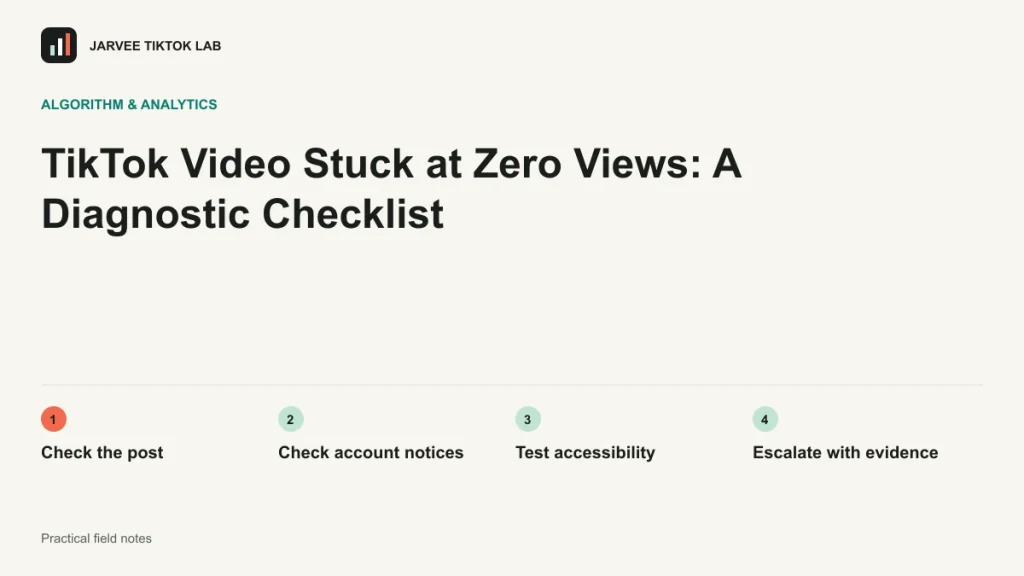
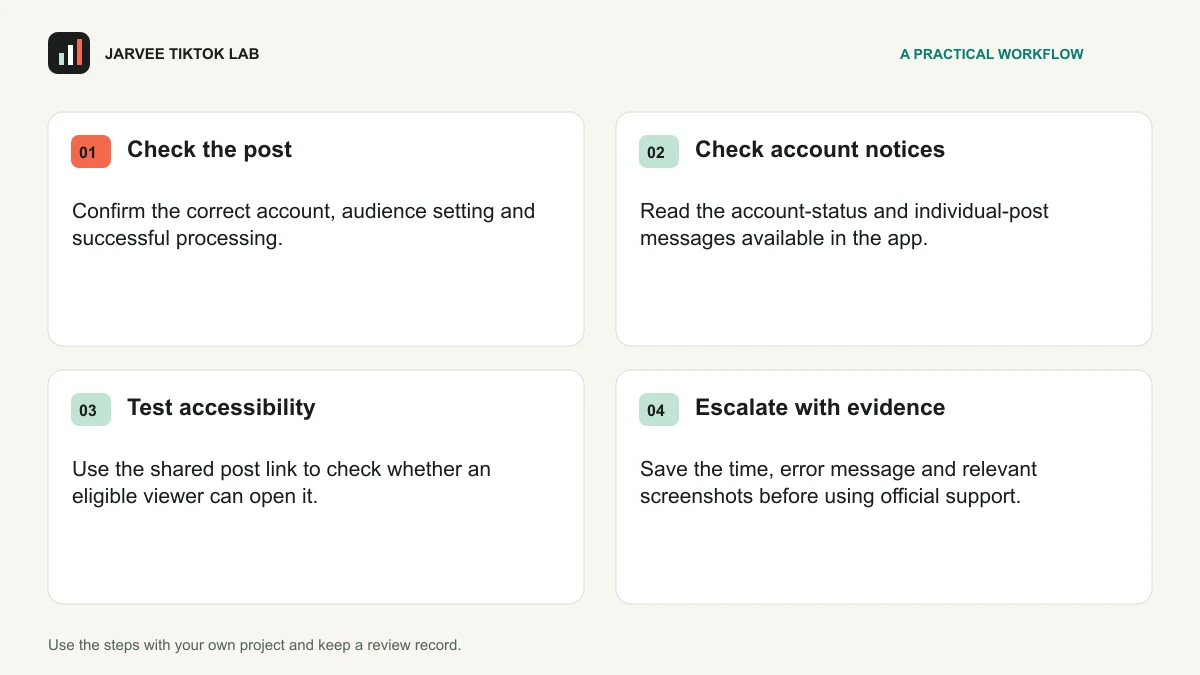
- Check the post. Confirm the correct account, audience setting and successful processing.
- Check account notices. Read the account-status and individual-post messages available in the app.
- Test accessibility. Use the shared post link to check whether an eligible viewer can open it.
- Escalate with evidence. Save the time, error message and relevant screenshots before using official support.
Try it on one project
Create a short incident log for one affected upload. Record what changed and what stayed the same. Avoid repeatedly deleting and reuploading the file while investigating because that makes the original sequence harder to reconstruct.
For a structured practice exercise, continue with the course lesson on testing and audience response.
Keep a useful review record
Choose an observation period before comparing posts. Record the audience question, format and length beside the available metrics. Compare similar work and keep unusually strong or weak results visible without treating an outlier as a permanent rule. If several things changed together, the result may not tell you which change mattered. The next test should reduce that uncertainty rather than repeat every feature of a successful post.
| Record | What to keep |
|---|---|
| Question | The specific uncertainty this piece of work should help resolve. |
| Version and context | The approved material, intended audience and observation period. |
| Observed result | What happened, with relevant definitions and any unexpected issue. |
| Next decision | One change to test, its owner and a date to review it. |
Separate a technical failure, an explicit platform notice and an ordinary performance observation. They call for different next steps. If a notice exists, use its actual wording. If the issue is creative, examine the opening, evidence and connection to the intended audience before proposing an account-wide explanation.
Two questions before the next iteration
Can one post prove an algorithmic rule?
One observation can suggest a question, but it does not reveal a complete ranking system. Look for a consistent pattern across comparable work and distinguish an official requirement from your own hypothesis.
What should I compare before changing the plan?
Keep the purpose, format, length and review period beside the result. When those conditions differ, describe the difference instead of assuming that the largest number proves a particular tactic.
To move approved work into a repeatable publishing process, compare your checklist with SMTasker Publish for TikTok. Start with one concrete task and review the actual output before expanding the workflow.
For the next part of the work, read How the TikTok Algorithm Works: A Practical Ranking Guide and keep the practical output beside your review notes.
Official reference
TikTok: how recommendations work. Check the current requirements and feature availability for your actual account and market when applying this guide.